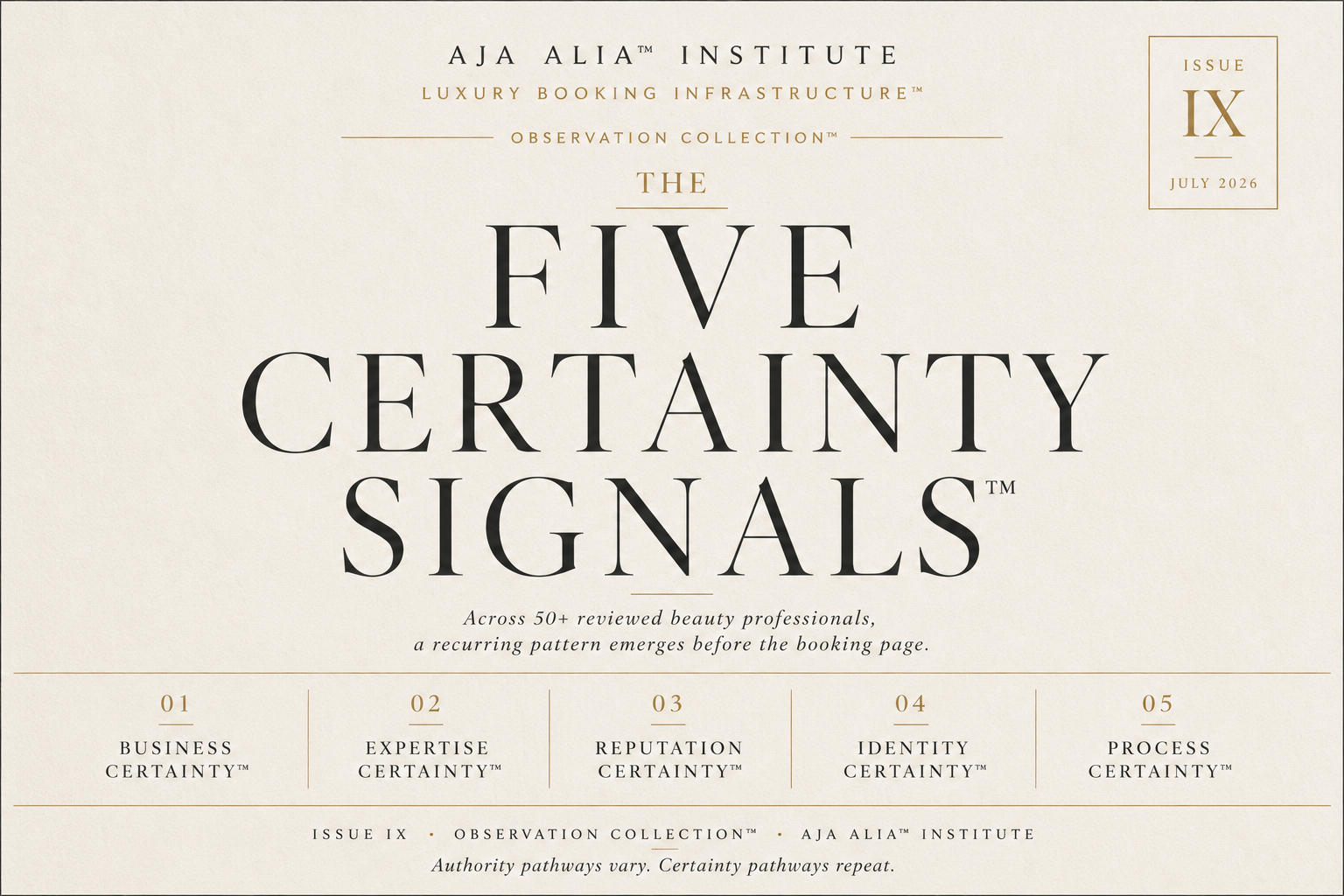
The Five Certainty Signals™ That Help Explain Whether a Qualified Prospect Books or Withdraws.
A recurring pattern observed across more than 50 beauty professionals personally reviewed by AJA ALIA™ Institute: the booking decision often begins forming before the booking page — and five specific categories of trust evidence appear to shape whether it continues or quietly stalls.
“Across the reviewed archive, skill is rarely the final question. The prospect is also evaluating legitimacy, expertise, reputation, personal fit, and process visibility — often before she reaches the booking page at all.”
AJA ALIA™ Institute · Observation Collection™ · Issue IX01. What the five certainty signals actually are — and why beauty clients need all five before they book.
Across more than 50 beauty professionals personally reviewed by AJA ALIA™ Institute, a recurring pattern appears in the pre-booking window. The prospect is qualified and interested. However, after finding the business, evaluating the portfolio, and reading the reviews, she hesitates. The hesitation is not about the quality of the work. It is about something the business has not yet communicated — one or more of the five certainty signals that appear to shape the pre-booking decision.
The booking decision, as established in Issue VIII, often begins forming before the booking page. Furthermore, it appears to be shaped by the presence or absence of five specific categories of trust evidence. When all five are present and visible in the pre-booking window, the prospect encounters fewer unanswered questions. When several are absent, hesitation becomes more likely — and the business often has no mechanism for understanding why.
The five certainty signals are not marketing frameworks. Instead, they are observed patterns — documented across a growing archive of beauty business reviews — that emerge repeatedly as infrastructure areas where pre-booking hesitation appears to concentrate. Moreover, each signal represents a category of question the prospect is attempting to resolve before she commits.
Authority pathways vary.
Certainty pathways repeat.
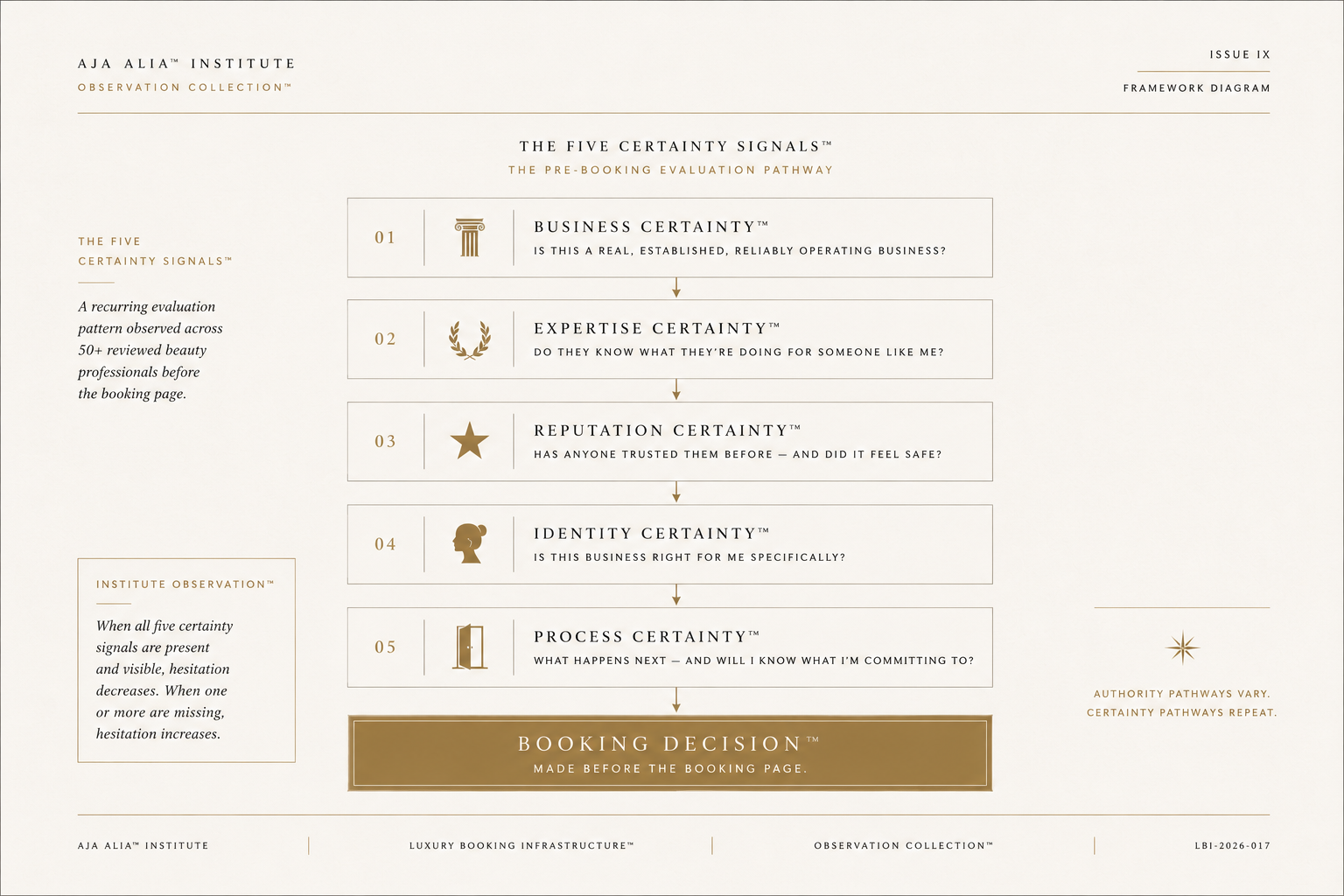
02. The five certainty signals — documented from the archive.
Each certainty signal represents a category of evidence that a qualified prospect may evaluate in the pre-booking window. The signals do not always appear in a fixed sequence. A prospect may begin evaluating several of them within the first moments of encountering a brand, while another may move through them more gradually. The order in which they surface varies. The observation that they each appear to influence the pre-booking decision does not.
A recurring observation in the archive: most beauty businesses communicate legitimacy. However, very few communicate stability. A prospect visiting a business for the first time is not only asking whether it is real — she is asking whether it will still be there when she needs it next month. Business Certainty™ requires both, yet most businesses only deliver one. Inconsistent Google Business hours, outdated booking links, and unavailable calendars are not marketing problems. Instead, they are Business Certainty™ failures — not because the business is unstable, but because the signals suggest it might be.
In plain English: she needs to know you’re here, you’re open, and you’ll still be here when she’s ready. When that is clear, you stop being asked to confirm it yourself.
A repeated pattern observed in the archive: expertise is present — in the service menu, in the portfolio, in credentials and training — and yet it does not reach the prospect in the pre-booking window where her decision is forming. Expertise Certainty™ requires not only that expertise exists, but that it is positioned where and when it matters. A portfolio buried three scrolls deep on a website is not functioning as a certainty signal. Specialization buried in a services dropdown is similarly invisible. Consequently, expertise that exists but is not positioned at the decision point of the client journey produces the same outcome as expertise that does not exist at all.
In plain English: expertise positioned before commitment is certainty infrastructure. Expertise positioned after commitment is documentation. Positioned well, it answers her question before she has to ask you directly.
A common hesitation pattern emerging from the archive: the businesses under review have reviews — in most cases, five stars. Nevertheless, those reviews describe outcomes rather than experiences. A first-time prospect does not need to know that the result was excellent. She already believes it will be. What she is searching for, instead, is evidence that the experience will feel safe. Outcome reviews satisfy existing clients. Experience reviews, however, convert new ones. Reputation Certainty™ requires the latter. Within the reviewed archive, outcome-focused reviews appeared more frequently than detailed descriptions of the client experience — and Reputation Certainty™ appears to suffer as a result.
In plain English: five stars tell her the outcome was good. Experience reviews tell her it will feel safe. Documented well, your reviews do that reassuring for you.
A recurring trust deficit documented in the archive: most beauty professionals communicate expertise clearly. Most, however, do not communicate fit. The prospect who hesitates is often not doubting skill — she is asking a different question entirely. Not “is this business good?” but “is this business right for me?” Identity Certainty™ is the signal that answers that question before she has to ask it. Additionally, it is the least intentionally built signal in the reviewed archive. Expertise is communicated deliberately. Identity, by contrast, is frequently assumed. The assumption creates hesitation — specifically, it produces qualified prospects who admire the work, feel unseen in the brand, and quietly find someone whose specialization they can recognize in themselves.
In plain English: she needs to see herself in your brand before she trusts you with her hair. When she already sees herself there, she arrives pre-qualified.
Across 50+ reviewed beauty professionals, a recurring pattern emerges at the threshold of commitment: the booking link exists, but the booking experience does not. The calendar is live, the intake form is present, and the confirmation message is automated — yet the prospect hesitates at the moment of action. The observation is not that the booking process is technically broken. Instead, the observation is that it communicates nothing. No reassurance, no process visibility, no signal of what the client is committing to or what happens next. Consequently, Process Certainty™ — which emerged repeatedly as an underdeveloped signal across the reviewed archive — functions as a frequent barrier between interest and commitment. A prospect who cannot see what she is committing to will delay commitment indefinitely.
In plain English: the booking link is not the booking experience. Process visibility reduces hesitation. Made visible up front, it answers the question before she has to ask you to walk her through it.
03. What happens when a certainty signal is missing — a pattern from the archive.
The Hesitation Pattern
When any of the five certainty signals is absent in the pre-booking window, a predictable pattern emerges. The prospect pauses. She continues researching. She visits a competitor. She may return days or weeks later — or she may not return at all. However, from the business’s perspective, the event is invisible. There is no abandoned cart notification. There is simply a qualified prospect who was interested and is now gone, and the business has no mechanism for understanding why.
The Most Frequently Observed Gap
Process Certainty™ appears repeatedly among the most underdeveloped signals in the reviewed archive. Business Certainty™ gaps also appeared frequently — particularly across Google Business Profile information, operating hours, booking links, and platform consistency. Identity Certainty™ is the least intentionally constructed. Expertise Certainty™ exists in many reviewed businesses but is frequently positioned where prospects are unlikely to encounter it. Reputation Certainty™ is present but weighted, within the reviewed archive, toward outcomes rather than experience. Therefore, many of the reviewed businesses showed weakness across more than one certainty category.
04. How to audit your own certainty infrastructure before investing in more visibility.
Certainty Infrastructure Before Visibility
The most consistent finding across the reviewed archive is not that businesses lack effort. However, visibility is frequently being amplified before the certainty infrastructure beneath it is strong enough to convert the attention it generates. Consequently, more visibility produces more prospects who arrive, hesitate, and leave without inquiring.
The diagnostic question is not “how do I get more visibility?” Instead, the more useful question is “which of the five certainty signals appears weak or absent in my pre-booking window — and is that gap contributing to the hesitation I am observing?”
Five Questions for Self-Audit
Business Certainty™: If a prospect researched your business for the first time today — your Google profile, your website, your booking page — would she immediately conclude that your business is legitimate, stable, and reliably operating?
Expertise Certainty™: Is your specialization visible within the first moments of encountering your brand on any platform? Or does it require her to scroll, click, or search for it?
Reputation Certainty™: Do your reviews describe what the experience felt like — the consultation, the communication, the process — or do they describe only the outcome?
Identity Certainty™: Can a first-time prospect immediately identify herself as your ideal client — or does your brand speak to everyone and therefore to no one in particular?
Process Certainty™: Does your pre-booking experience make the next step visible and safe to take — or does the prospect reach your booking link and still not know exactly what she is committing to?
05. Certainty creates capacity — the outcome beyond bookings.
One recurring observation appears throughout the archive. As certainty increases, the amount of manual communication required to move a client forward often decreases. Clients ask fewer clarification questions. They require less reassurance. They move through the process with greater confidence, arriving with a clearer understanding of what happens next.
For beauty professionals, the impact extends beyond booking behavior. The absence of certainty frequently creates additional administrative work. Questions must be answered repeatedly. Policies must be explained manually. Expectations must be clarified one conversation at a time.
When certainty is visible before inquiry, much of that clarification can occur before a direct conversation ever begins. The result is not simply a more informed prospective client. It is often a more efficient business. In this way, certainty may function as more than a conversion influence. It may also create operational capacity.
The Core Outcome Layer™
Followed to its conclusion, the five certainty signals do not only produce more bookings. They produce a business that is easier to run.
Infrastructure
Freedom
Not merely helping a beauty professional get booked, but helping her build a business that is easier to find, easier to trust, easier to book, and ultimately easier to manage.
Methodology Archive™ · Issue IX Framework Reference
Certainty™
Certainty™
Certainty™
Certainty™
Certainty™
The strongest booking systems in the reviewed archive do not wait for the client to arrive at the booking page and attempt persuasion. Instead, they build certainty across all five signals before the decision window closes — so that when she reaches the booking page, she encounters fewer unanswered questions. She is not deciding under uncertainty. She is confirming what the pre-booking window already communicated.
The result is often fewer repetitive questions, fewer manual explanations, and a booking process that depends less on the owner to create clarity in real time.
Visibility creates attention. Infrastructure creates stability.
Trust is rarely created by one asset.
It is accumulated through five certainty signals — built before the booking page.
AJA ALIA™ · Issue IX · Observation Collection™ · Methodology Archive™Discover where your booking process may be creating unnecessary questions, manual communication, and hidden friction before a client ever reaches your chair.
Begin Your Infrastructure Review™