The Website Is the Asset.
Why most beauty professionals who want to build a business are building on land they do not own, and the infrastructure model that changes that.
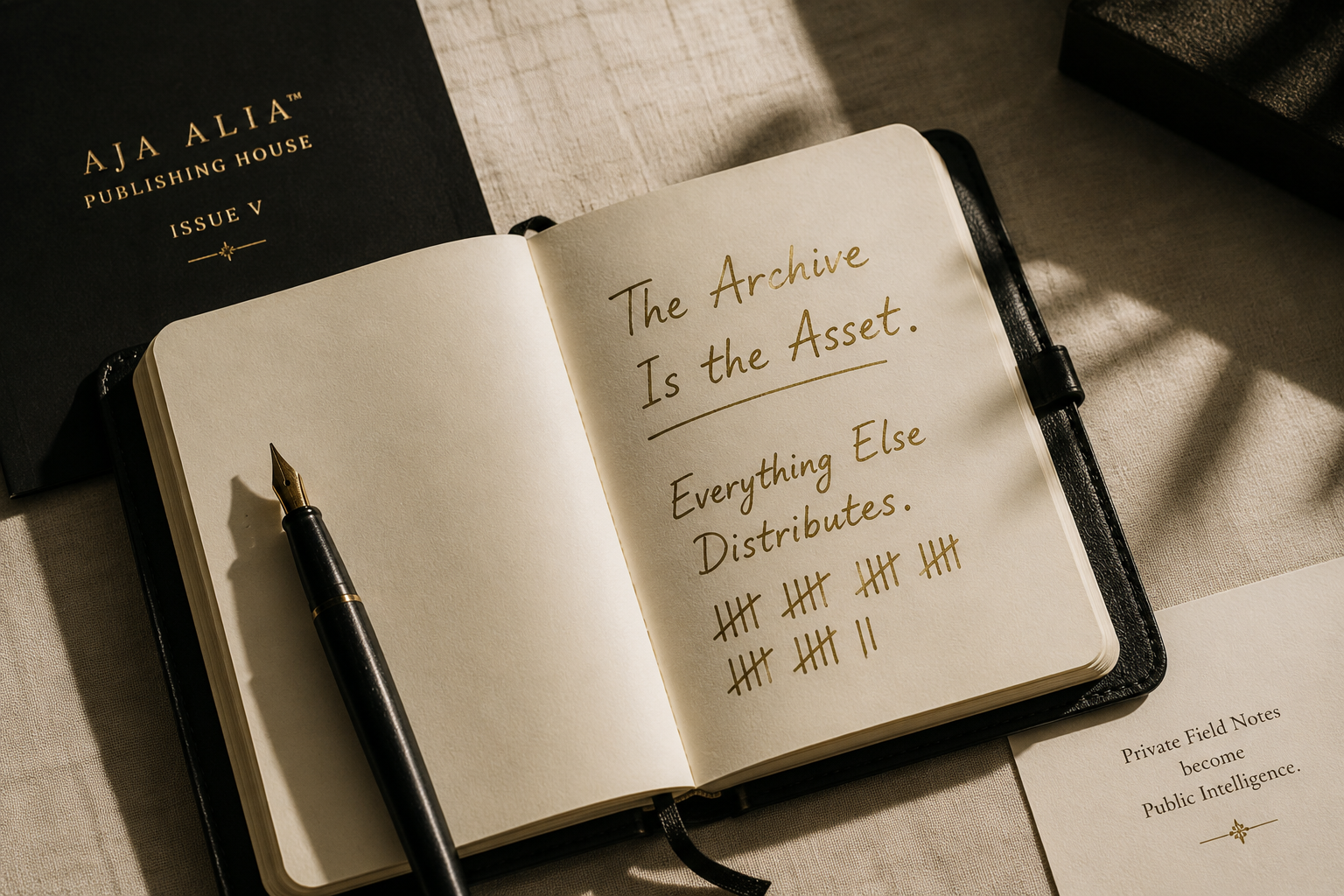
Most beauty professionals who want to build a business are building on land they do not own. This is not a content failure. It is an infrastructure failure, and the distinction between those two things changes everything about how a premium service business should structure its publishing week.
There is a version of this industry where a stylist spends three years building an Instagram following, develops a reputation, refines a point of view, and then wakes up one morning to an algorithm change that cuts their reach in half. There is another version where someone builds a Substack, nurtures a list, creates genuine trust with their readers, and discovers that the platform owns the relationship, not them.
Neither of these is a content problem. Both are infrastructure problems.
The question is not how much content you are producing. The question is where that content lives permanently. Where it accumulates. Where it builds authority that does not evaporate when a platform changes its terms.
The platform owns the distribution. You supply the content. That is the deal you agreed to when you signed up. Presence can be taken. Assets compound. The distinction between those two things is the entire infrastructure model.
Section OneWhat most beauty professionals are actually building.
Walk through what typically happens when a hairstylist or salon suite owner decides to get serious about their online presence. They open Instagram. They post consistently. Some of them start a TikTok. Some start a Substack. Some start all of these simultaneously, which is a different problem entirely.
What they are building is a presence on platforms they do not control, producing content that compounds inside those platforms’ systems rather than their own. Instagram’s algorithm decides who sees the work. Substack’s recommendation engine decides who discovers the writer. TikTok’s For You page decides who gets the reach.
These are not businesses. They are tenant arrangements.
There is nothing wrong with using platforms. The error is confusing presence on a platform with ownership of an asset. Presence can be taken. Assets compound. They are not the same thing, and the distinction changes what you should prioritize in any given week.
You supply the content.
That is the deal you agreed to when you signed up. · Platform vs Asset™ · Issue V
Section TwoWhat compounds and what does not.
The distinction between a platform and an asset comes down to compounding. An asset gains value over time without requiring proportionally more effort to maintain it. A platform presence requires continuous output to maintain visibility. The moment you stop producing for the platform, your presence begins to decay.
The website is the only channel in the content ecosystem where every compounding mechanism works simultaneously.
| Channel | You Own It | SEO Compounds | Authority Builds | Can Be Taken |
|---|---|---|---|---|
| Your Website Blog | Yes | Yes | Yes | No |
| Email List (your domain) | Yes | No | Partial | No |
| No | Partial | Partial | Partial | |
| No | No | No | Yes | |
| Substack | No | No | Partial | Partial |
| TikTok | No | No | No | Yes |
SEO compounds on the website. Internal links compound. Each new essay strengthens the ones before it. Google indexes the archive. Pinterest pins link back to it. The audit page gains domain authority from every essay published around it. The website is the only thing you build that gets more valuable the longer you maintain it, without requiring proportionally more effort.
The archive becomes the asset.
None of this is true of your Instagram grid. · Compounding Infrastructure™ · Issue V
Section ThreeThe Distribution Hierarchy™.
Understanding the compounding table reframes every platform decision. Platforms are not competitors for your attention. They are distribution channels for your archive. The hierarchy becomes clear once you name it.
Six layers. One canonical source.
Website Blog.
The canonical home. Every essay lives here permanently. SEO builds here. Internal links accumulate here. Google indexes your expertise here. Every other channel points back to this layer. The blog is not a channel. It is the source.
Email List.
The owned audience. Captured through the website, not through a third-party platform. People subscribe long before they buy an audit. The list captures them during the trust-building phase. The list is the value. Any platform hosting it is the pipe.
Pinterest.
The discovery engine. Pins link back to the blog. Authority compounds over time. Content lifecycle is measured in months and years, not days. The most underutilized channel in premium beauty for exactly the audience this firm is building toward.
Google Search.
Finds you when someone searches for what you know. This is the channel that works while you sleep. A prospective client searching why premium clients ghost beauty appointments should find this archive in the results. That only happens if the archive exists.
Social Channels.
Instagram, Threads, LinkedIn, TikTok. Awareness and traffic channels. These drive people toward the archive. They do not replace it. The goal of every social post is to move a prospective client one step closer to the website, the email list, or the audit page.
Substack.
The syndication layer. The essay publishes to the blog first, establishing it as canonical content. Then it syndicates through Substack for email distribution. The list grows passively while the content continues compounding on the blog. Substack’s recommendation ecosystem provides additional discovery. The canonical home never changes. Substack is the pipe.
The essay is written once. It goes to the blog first. Then it is syndicated to Substack. Then Monday, Wednesday, and Friday content is derived from it. Pinterest pins are derived from it. LinkedIn captions are derived from it. One source. Many channels. The source lives on your domain.
Section FourWhat Substack actually is in this model.
Substack is useful. The error is mistaking it for the center of the ecosystem.
What Substack does well is capture people during the trust-building phase of the client journey. The buying cycle for a premium service like the Brand + Booking Audit™ is not observe-then-buy. It is observe, follow, read, trust, then buy. Substack captures people at the reading stage. The email list grows passively while the content continues compounding on the blog.
Substack also adds publishing credibility. There is a psychological difference between being told to read someone’s blog and being invited to subscribe to Issue V of a publishing house. The latter feels institutional. It signals that there is a body of work, a numbering system, a house style. That aligns with the AJA ALIA™ brand position.
Most creators use Substack as the business. AJA ALIA™ uses Substack as distribution infrastructure. The essay is not a Substack post that also appears on the blog. It is a blog post that is also syndicated through Substack. That distinction is the entire model.
If Substack were to close tomorrow, the essays would remain on the website. The email list would need to migrate. The archive would be intact. That is the correct relationship with any distribution platform. The platform is useful. The platform is not the asset.
Section FiveThe archive as the real offer.
The archive is not just a record of thinking. It is infrastructure that sells the offer before the offer page loads.
A prospective client who arrives at the Brand + Booking Audit™ page after reading four or five essays on conversion infrastructure has already made most of the trust decision. The audit page closes the transaction. The archive built the relationship.
The internal links are not an SEO tactic. They are the connective tissue of the archive. Each essay that links to the audit page strengthens the audit page’s authority in search. Each essay that links to a previous essay deepens the reader’s understanding of the framework. The archive becomes a curriculum.
who has published forty essays on the subject.
The archive does the selling before the audit page even loads. · The Archive Model™ · Issue V
Section SixThe Archive Production Principle™.
The strongest publishing systems do not begin with platforms. They begin with a single idea.
That idea becomes an essay. The essay becomes the archive. The archive becomes discoverable through search. The archive becomes shareable through distribution. The archive becomes trust through repetition.
Most creators begin with distribution and hope that authority follows. They optimize for reach before they have built anything worth reaching. They produce volume before they have established a point of view worth returning to.
The stronger model inverts this. It begins with the idea. It builds the essay. It publishes to the archive first. Then it lets distribution follow from authority rather than chasing authority through distribution.
Why the inversion matters.
The consequence of this inversion is significant. When distribution is the source, the creator is always chasing the next post. When the archive is the source, every post is pointing somewhere. The individual piece of content is not the destination. It is the introduction. The archive is the destination. The archive is the offer.
One idea. One essay. One archive entry. Many expressions. The expressions distribute. The archive remains.
This is not a volume argument. It is not an argument for posting less or producing less. It is an argument for knowing what the canonical source is and ensuring that everything else serves it. The essay is the source. The archive is the accumulation. The distribution is the signal that points people back toward the thing that was built to last.
Most beauty professionals are producing expressions without building the archive. They are generating distribution without creating the thing worth being distributed. Volume without a canonical home is noise. The same volume with an archive behind it is authority.
Section SevenWhat this looks like in twelve months.
In twelve months of this model, AJA ALIA™ would have approximately fifty essays in the archive. Each one indexed by Google. Each one building authority toward the offer pages. Each one linked to the others in a web that signals expertise to both search engines and human readers.
That archive is something no algorithm change can take away. It is something no platform policy can revoke. It is something that continues working while the founder is in a consultation, on a shoot, at rest.
The strongest version of AJA ALIA™ is a media property as much as a consultancy. The frameworks become searchable. Trust Bottleneck™, Certainty Load™, Conversion Infrastructure™ — these terms live in the archive first. They spread through distribution second.
Fifty essays indexed by Google is infrastructure. Not content. Infrastructure. The archive does the selling before the audit page loads. The founder is no longer the system — she is the architect of it.
The website is not just where you put your content. It is where your authority accumulates. The archive is the real asset. The blog is the publishing house. Everything else distributes. The archive remains.
The blog is the publishing house.
Everything else distributes. The archive remains. · The Archive Model™ · AJA ALIA
Brand + Booking Audit™
If your website is not working as a trust-building asset — if prospective clients are arriving at your booking page without enough context to say yes — the Brand + Booking Audit™ identifies exactly where the infrastructure is failing and what to build first.
Book the Audit → Or read Issue V on Substack · AJA ALIA™ Publishing House ›Frameworks & citations referenced
- ME-015 The Website Is the Asset™. The foundational principle of the AJA ALIA™ publishing model. Issue V.
- ME-016 Rented Land™. Any platform a founder publishes to that she does not own. Presence on rented land requires continuous output to maintain. It does not compound.
- ME-017 The Archive Model™. The long-term view of the AJA ALIA™ website as a searchable, interlinked body of work that builds domain authority, client trust, and search visibility simultaneously.
- ME-018 The Distribution Hierarchy™. Six-layer model: Website Blog (canonical) → Email List (owned) → Pinterest (discovery) → Google Search (intent) → Social Channels (awareness) → Substack (syndication).
- ME-019 Platform vs Asset™. An asset gains value over time without proportionally more effort. A platform presence decays the moment output stops.
- ME-020 The One-Essay Workflow™. One idea becomes a canonical essay. The essay becomes the archive. Distribution channels express the idea in multiple forms while strengthening the canonical source.
- ME-021 The Syndication Layer™. Content publishes to the blog first, then syndicates through email distribution. The list is the value. The platform is the pipe.
- ME-022 Compounding Infrastructure™. Assets and systems that increase in value over time: SEO, internal links, Pinterest saves, domain authority, email list size, Google search impressions.
- Carried forward TL-001 to TL-026 (Trust Leak Encyclopedia™) · TSI-01 to TSI-12 (Trust Signal Inventory™) · ME-001 to ME-014 (Issues I–IV methodology archive).