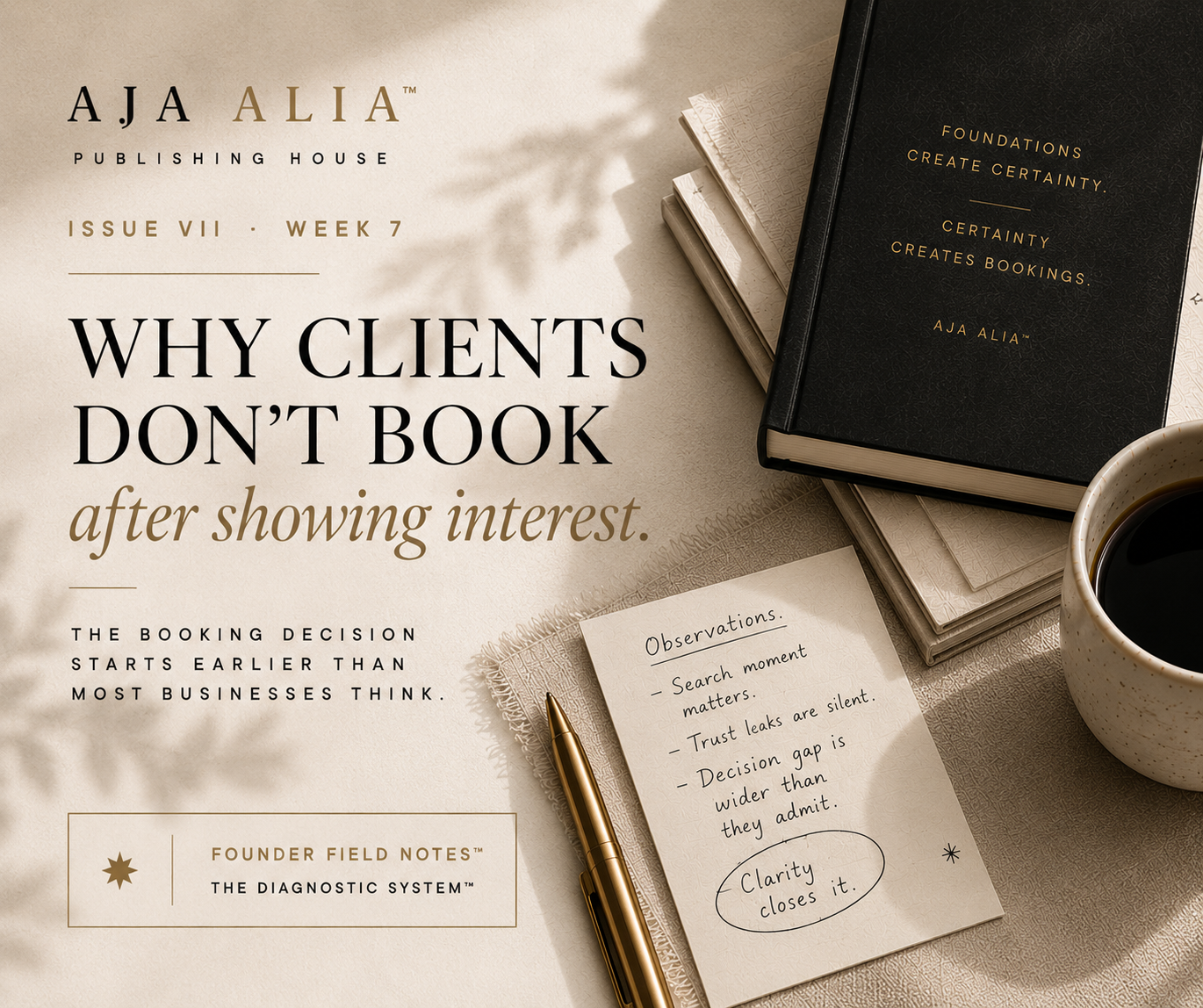
The Booking Decision Starts Earlier Than Most Businesses Think.
Most booking systems are designed around a single assumption: the client makes her decision at the booking page. The button, the calendar, the price — these are treated as the moment of conversion.
They are not.
By the time she reaches your booking page, much of the decision has already been made. The booking page is not the starting line. For clients, it is closer to the finish.
Issue VII documents what happens upstream — in the search moment, through trust signals, across proof and expectation-setting — and names the patterns that determine whether a client moves forward or quietly disappears.
01. Booking decisions start long before the booking page.
When a potential client finds your brand, she does not immediately decide to book. She decides to look closer. That is the Search Moment™. It is the first impression, and it sets the expectation for everything that follows.
From there, she enters what The Diagnostic System™ identifies as the Booking Decision Sequence: a sequence of trust signals, proof, and expectation-setting that runs long before she ever sees “Select a time.”
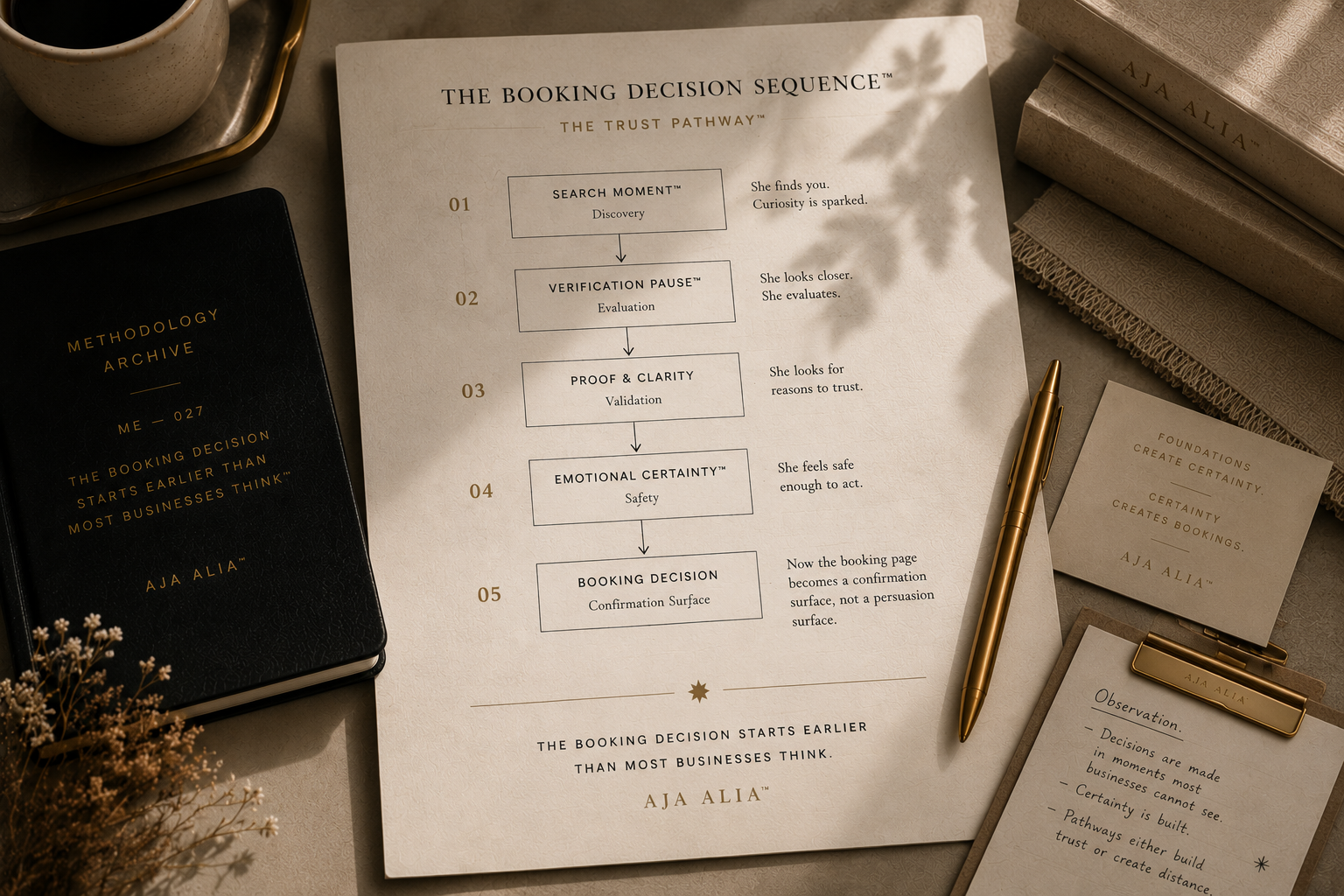
The Booking Decision Sequence™ · ME-027 · Methodology Archive
Most businesses design the booking page as if it carries the whole conversion. The Diagnostic System™ reveals that clients have already been deciding for some time before they arrive there. The page confirms. It does not persuade.
“The win is not getting the client to the booking page. The win is building the decision before they get there.”
Founder Field Notes™ · Issue VII02. Trust Pathways™ — How certainty accumulates upstream.
A Trust Pathway is the sequence of impressions, signals, and proof a client moves through before she feels safe enough to act. It is not a single moment. It is a progression.
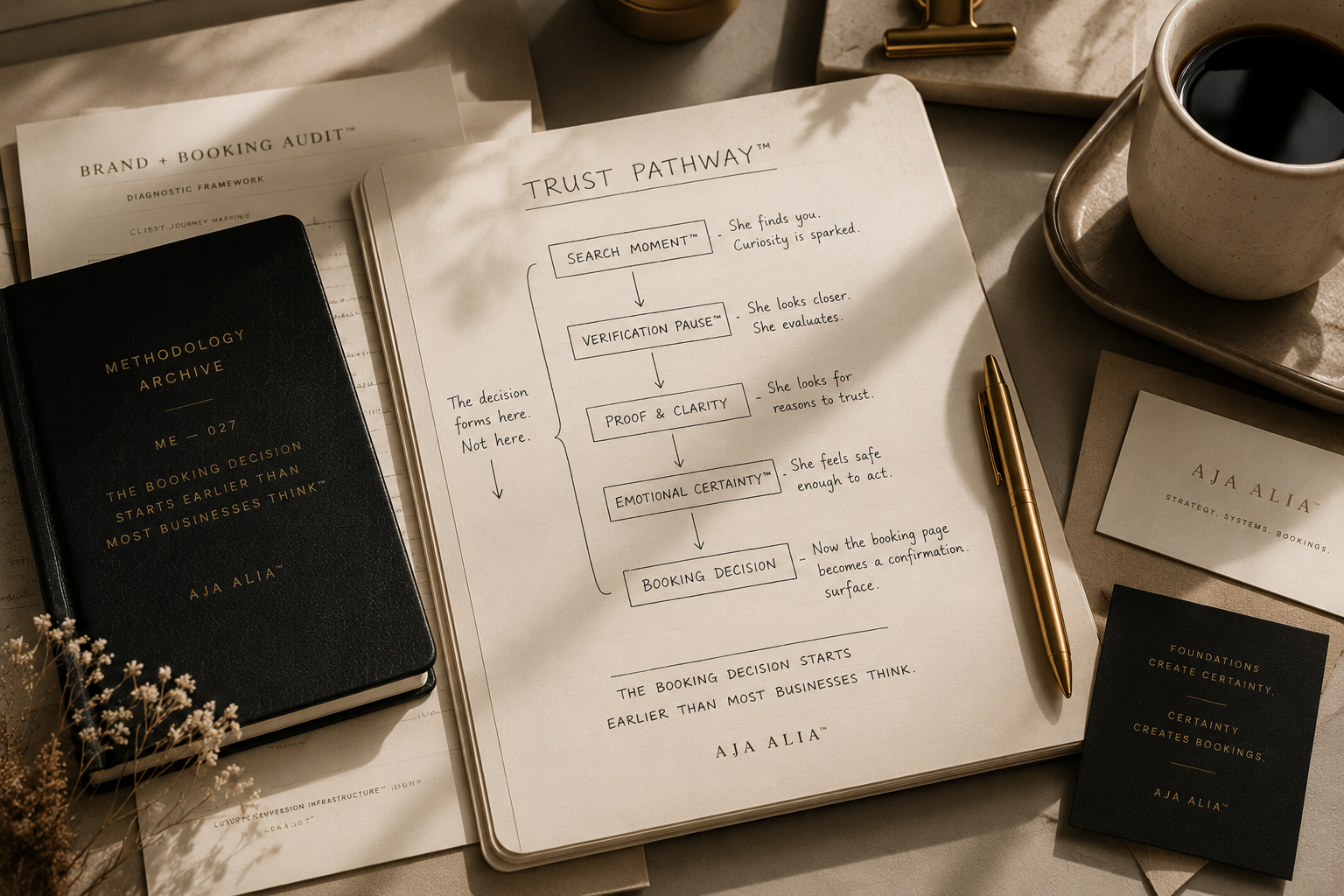
Trust Pathway™ · ME-027 · Methodology Archive
She finds you. Curiosity is sparked.
First impression sets the expectation.
She looks closer. She evaluates.
She compares, searches, and checks for signals of trust.
She looks for reasons to trust.
Proof removes doubt and builds confidence.
She feels safe enough to act.
Emotional certainty closes the gap between interest and action.
The booking page becomes a confirmation surface, not a persuasion surface.
Action is a natural extension of certainty, not a leap of faith.
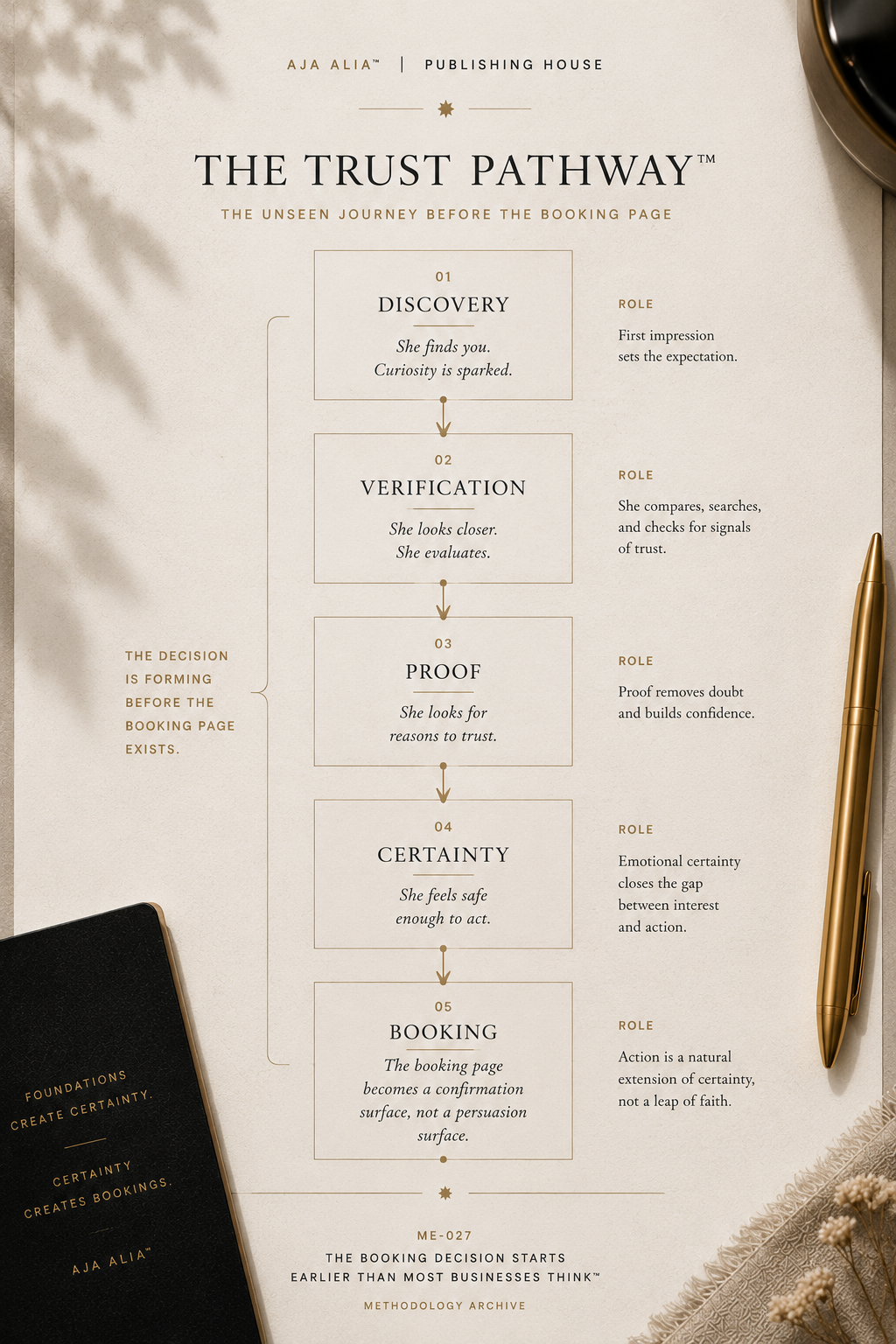
The Trust Pathway™ · AJA ALIA™ Publishing House
Trust is not a single moment. It is a sequence. Every touchpoint in a client’s journey either builds certainty or introduces distance. The business that understands this designs for the entire pathway — not just the final page.
03. Protection Before Connection™ — When policies appear before trust.
One of the most consistent patterns identified across audits this week: brands introducing protection before they establish connection.
Deposits, cancellation policies, requirements, and intake forms are not the problem. The problem is sequence.
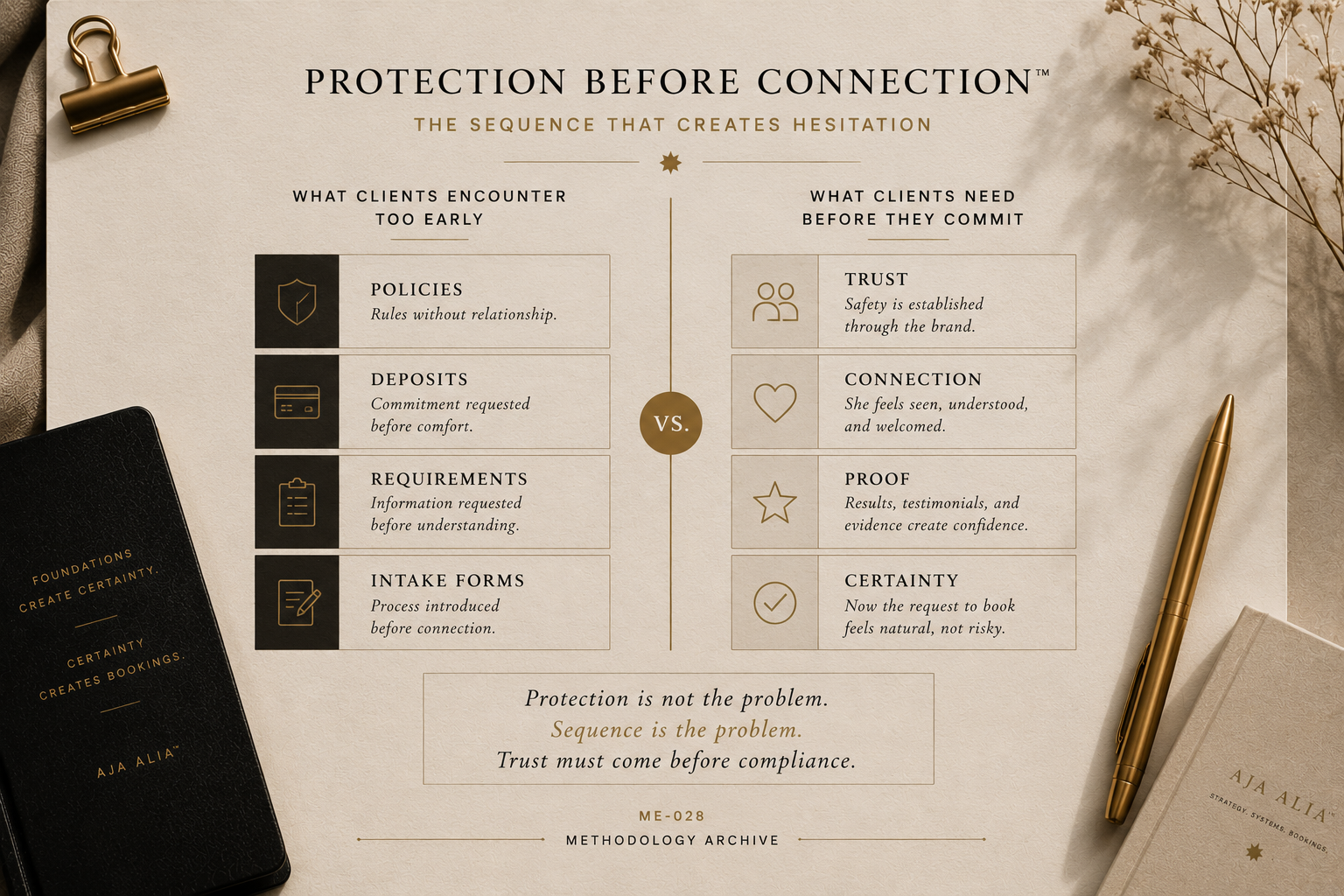
Protection Before Connection™ · ME-028 · Methodology Archive
What Clients Encounter Too Early
Policies
Rules without relationship.
Deposits
Commitment requested before comfort.
Requirements
Information requested before understanding.
Intake Forms
Process introduced before connection.
What Clients Need Before They Commit
Trust
Safety is established through the brand.
Connection
She feels seen, understood, and welcomed.
Proof
Results, testimonials, and evidence create confidence.
Certainty
Now the request to book feels natural, not risky.
Protection is not the problem. Sequence is the problem. When policies appear before trust has been established, the Emotional Certainty Gap™ widens. Clients feel managed before they feel understood. Proof before protection creates partnership. Protection before proof creates pressure.
Policies are strongest when they sit on top of established certainty — not in front of it. Trust must come before compliance.
04. Authority Without Pathway™ — Visible skill, invisible path.
The second diagnostic pattern identified this week is more subtle and more common.
Strong portfolio. Clear expertise. Excellent reviews. The brand communicates authority at every turn. And yet — the client hesitates. She does not book. She disappears.
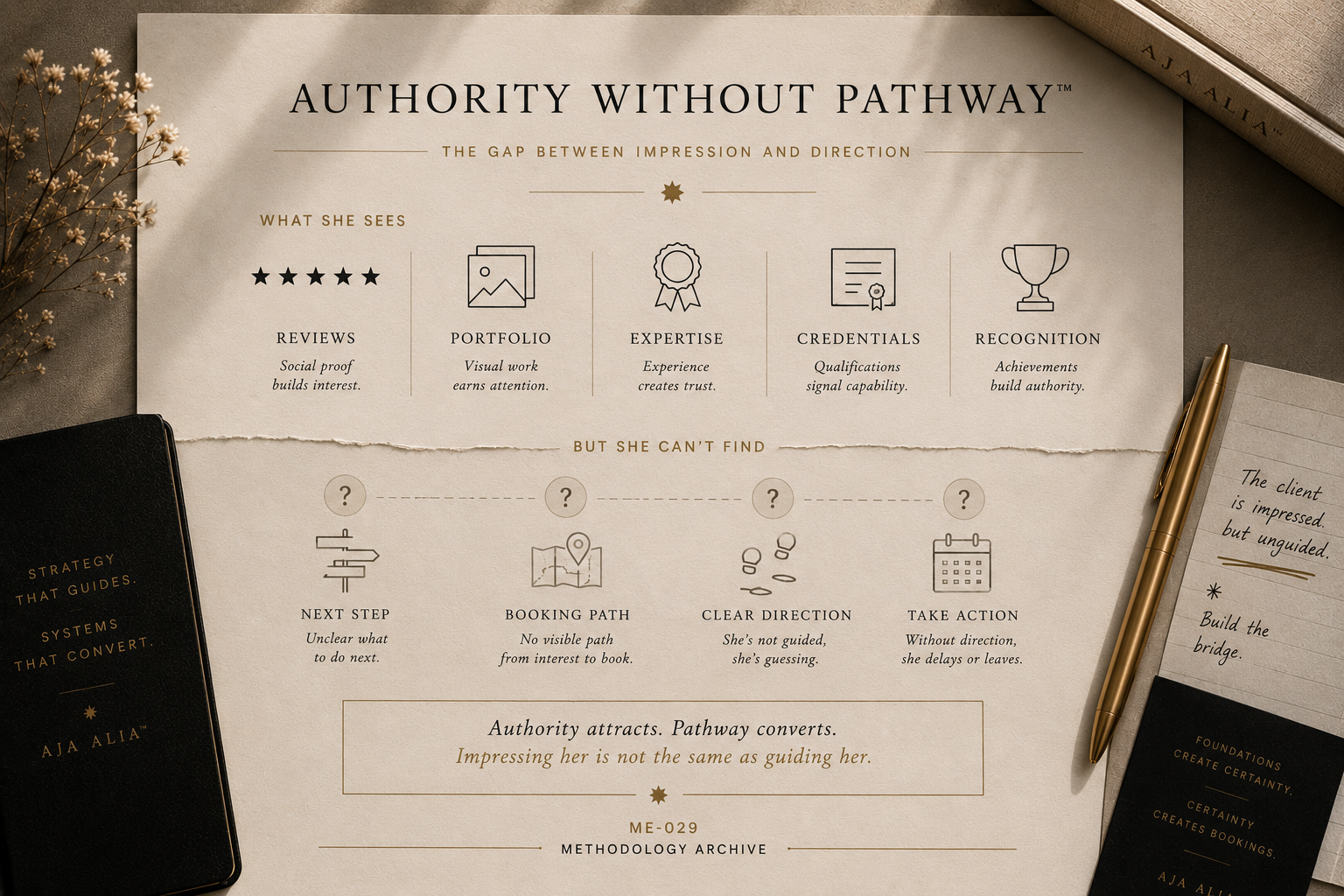
Authority Without Pathway™ · ME-029 · Methodology Archive
The audit identifies this as Authority Without Pathway™. The issue is not authority. The issue is direction. She is impressed, but unguided. She cannot find the next step. Without direction, she delays — or she leaves.
Authority attracts. Pathway converts. Impressing a client is not the same as guiding her. When visible authority is not paired with clear direction from interest to booking, the client feels informed but uncertain. She knows the work is excellent. She does not know what to do next. Build the bridge.
05. Emotional Certainty Gap™ — Why hesitation feels like silence.
Underlying both patterns is a single mechanism: the Emotional Certainty Gap™.
The Emotional Certainty Gap is the distance between a client’s recognition of expertise and her felt safety to act. She may see the work. She may acknowledge the quality. But if trust has not been built, if the pathway is unclear, if protection has arrived before connection — she will not book.
She will not tell you why. She will simply go quiet.
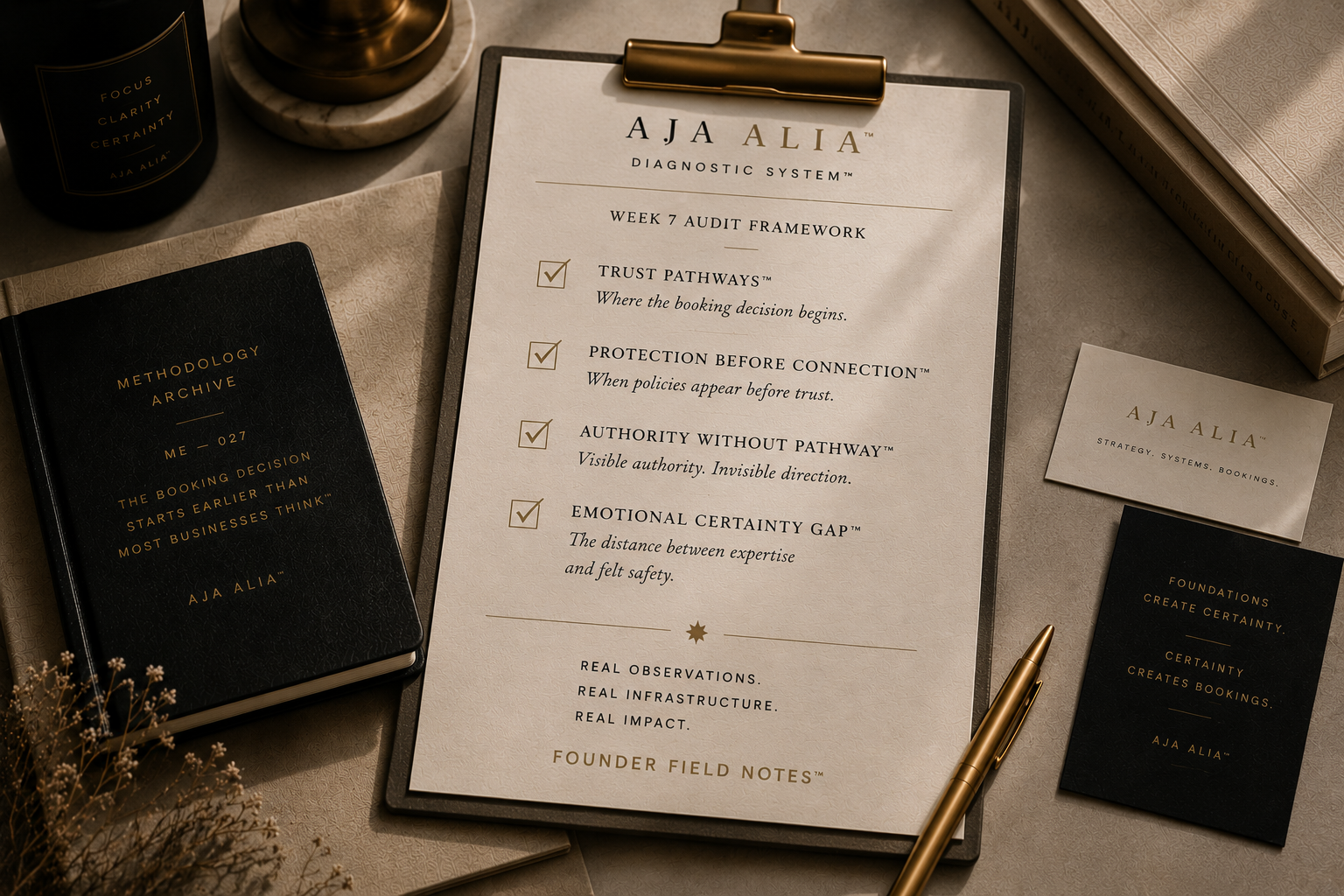
Week 7 Audit Framework · AJA ALIA™ Diagnostic System™
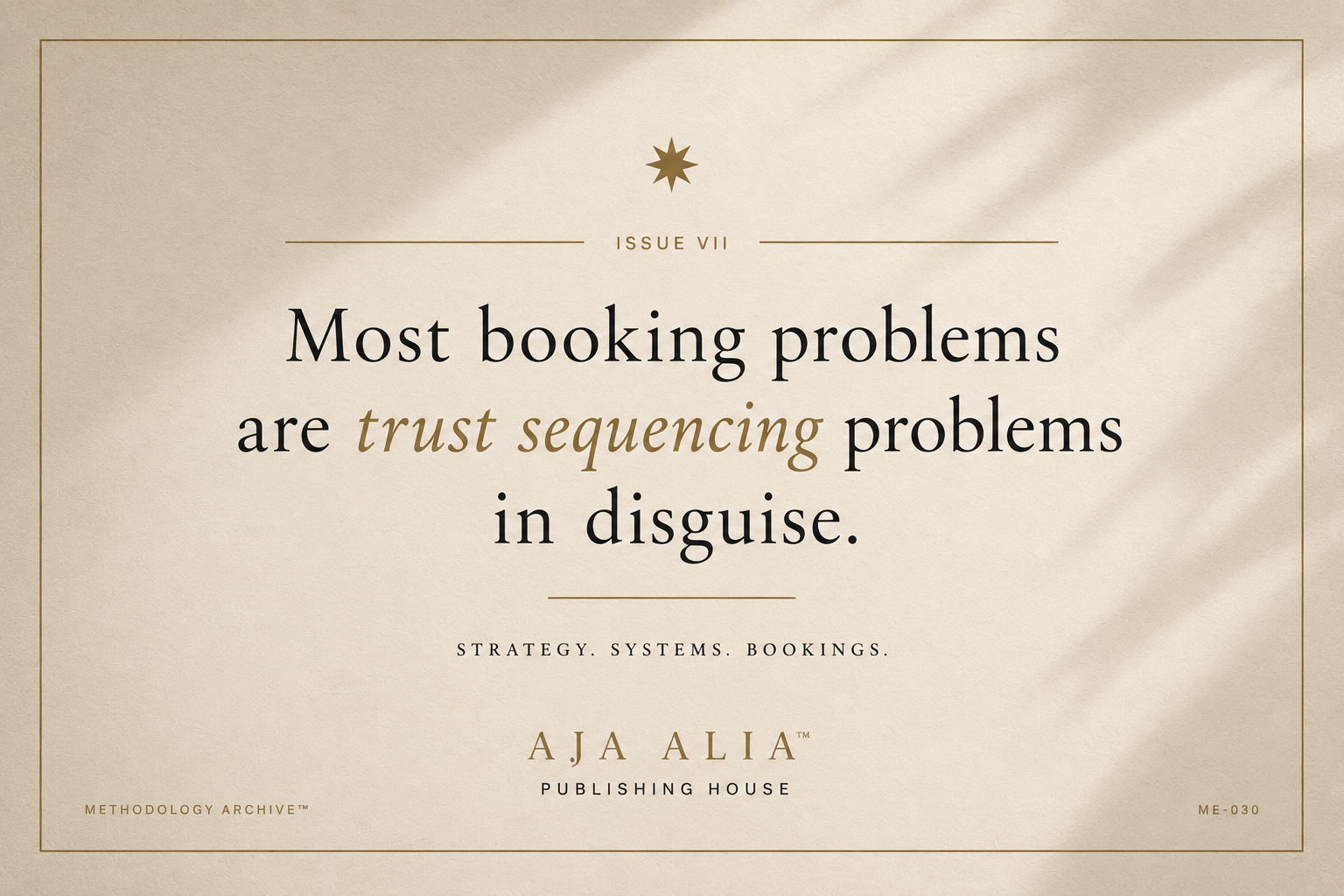
“Most booking problems are trust sequencing problems in disguise.”
ME-030 · Methodology Archive · AJA ALIA™The gap is not filled by better photos, more posts, or a redesigned booking page. It is filled by certainty — built upstream, through the Trust Pathway, in the right sequence.
06. Designing booking systems that earn trust before asking for action.
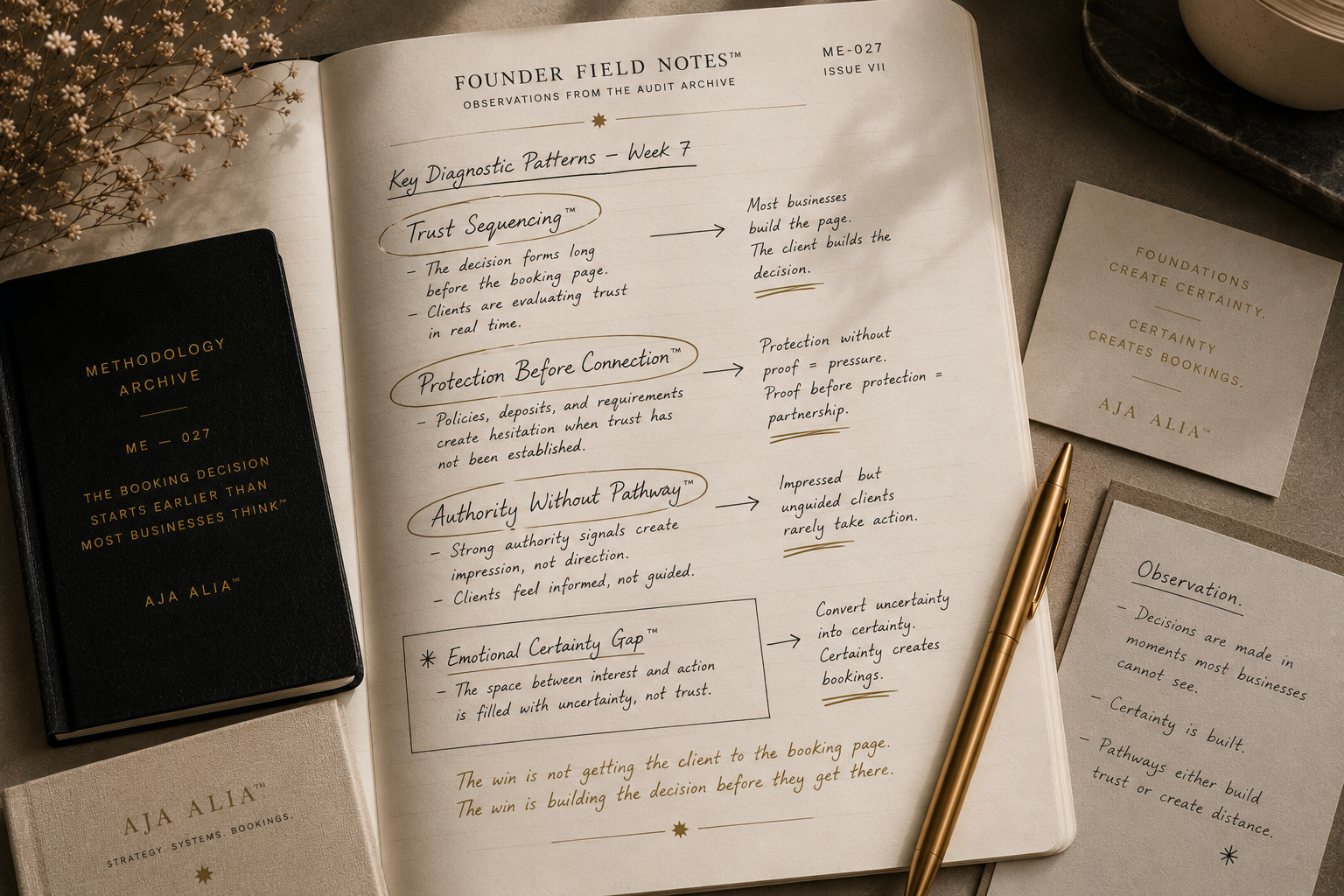
Founder Field Notes™ · ME-027 · Issue VII
The Diagnostic System™ does not produce recommendations for more content. It identifies where in the sequence certainty breaks down — and what infrastructure is missing.
Trust Sequencing™
The decision forms long before the booking page. Clients are evaluating trust in real time. Most businesses build the page. The client builds the decision.
Protection Before Connection™
Policies, deposits, and requirements create hesitation when trust has not been established. Proof before protection creates partnership. Protection before proof creates pressure.
Authority Without Pathway™
Strong authority signals create impression, not direction. Clients feel informed, not guided. Impressed but unguided clients rarely take action.
Emotional Certainty Gap™
The space between interest and action is filled with uncertainty, not trust. Converting uncertainty into certainty is the infrastructure work. Certainty creates bookings.
The strongest booking systems do not wait for the client to arrive at the page and then attempt persuasion. They build certainty across the entire pathway — so that when she reaches the booking page, she is not deciding. She is confirming.
Foundations create certainty. Certainty creates bookings.
“The booking page is not where the decision happens.
It is where certainty lands.”
See where your booking decision actually begins — and where certainty breaks down in your infrastructure.
DM BOOKED · Brand + Booking Audit™
The Booking Decision Starts Earlier Than Most Businesses Think.
Most booking systems are designed around a single assumption: the client makes her decision at the booking page. The button, the calendar, the price — these are treated as the moment of conversion.
They are not.
By the time she reaches your booking page, much of the decision has already been made. The booking page is not the starting line. For clients, it is closer to the finish.
Issue VII documents what happens upstream — in the search moment, through trust signals, across proof and expectation-setting — and names the patterns that determine whether a client moves forward or quietly disappears.
01. Booking decisions start long before the booking page.
When a potential client finds your brand, she does not immediately decide to book. She decides to look closer. That is the Search Moment™. It is the first impression, and it sets the expectation for everything that follows.
From there, she enters what The Diagnostic System™ identifies as the Booking Decision Sequence: a sequence of trust signals, proof, and expectation-setting that runs long before she ever sees “Select a time.”
The Booking Decision Sequence™ · ME-027 · Methodology Archive
Most businesses design the booking page as if it carries the whole conversion. The Diagnostic System™ reveals that clients have already been deciding for some time before they arrive there. The page confirms. It does not persuade.
“The win is not getting the client to the booking page. The win is building the decision before they get there.”
Founder Field Notes™ · Issue VII02. Trust Pathways™ — How certainty accumulates upstream.
A Trust Pathway is the sequence of impressions, signals, and proof a client moves through before she feels safe enough to act. It is not a single moment. It is a progression.
Trust Pathway™ · ME-027 · Methodology Archive
She finds you. Curiosity is sparked.
First impression sets the expectation.
She looks closer. She evaluates.
She compares, searches, and checks for signals of trust.
She looks for reasons to trust.
Proof removes doubt and builds confidence.
She feels safe enough to act.
Emotional certainty closes the gap between interest and action.
The booking page becomes a confirmation surface, not a persuasion surface.
Action is a natural extension of certainty, not a leap of faith.
The Trust Pathway™ · AJA ALIA™ Publishing House
Trust is not a single moment. It is a sequence. Every touchpoint in a client’s journey either builds certainty or introduces distance. The business that understands this designs for the entire pathway — not just the final page.
03. Protection Before Connection™ — When policies appear before trust.
One of the most consistent patterns identified across audits this week: brands introducing protection before they establish connection.
Deposits, cancellation policies, requirements, and intake forms are not the problem. The problem is sequence.
Protection Before Connection™ · ME-028 · Methodology Archive
What Clients Encounter Too Early
Policies
Rules without relationship.
Deposits
Commitment requested before comfort.
Requirements
Information requested before understanding.
Intake Forms
Process introduced before connection.
What Clients Need Before They Commit
Trust
Safety is established through the brand.
Connection
She feels seen, understood, and welcomed.
Proof
Results, testimonials, and evidence create confidence.
Certainty
Now the request to book feels natural, not risky.
Protection is not the problem. Sequence is the problem. When policies appear before trust has been established, the Emotional Certainty Gap™ widens. Clients feel managed before they feel understood. Proof before protection creates partnership. Protection before proof creates pressure.
Policies are strongest when they sit on top of established certainty — not in front of it. Trust must come before compliance.
04. Authority Without Pathway™ — Visible skill, invisible path.
The second diagnostic pattern identified this week is more subtle and more common.
Strong portfolio. Clear expertise. Excellent reviews. The brand communicates authority at every turn. And yet — the client hesitates. She does not book. She disappears.
Authority Without Pathway™ · ME-029 · Methodology Archive
The audit identifies this as Authority Without Pathway™. The issue is not authority. The issue is direction. She is impressed, but unguided. She cannot find the next step. Without direction, she delays — or she leaves.
Authority attracts. Pathway converts. Impressing a client is not the same as guiding her. When visible authority is not paired with clear direction from interest to booking, the client feels informed but uncertain. She knows the work is excellent. She does not know what to do next. Build the bridge.
05. Emotional Certainty Gap™ — Why hesitation feels like silence.
Underlying both patterns is a single mechanism: the Emotional Certainty Gap™.
The Emotional Certainty Gap is the distance between a client’s recognition of expertise and her felt safety to act. She may see the work. She may acknowledge the quality. But if trust has not been built, if the pathway is unclear, if protection has arrived before connection — she will not book.
She will not tell you why. She will simply go quiet.
Week 7 Audit Framework · AJA ALIA™ Diagnostic System™
“Most booking problems are trust sequencing problems in disguise.”
ME-030 · Methodology Archive · AJA ALIA™The gap is not filled by better photos, more posts, or a redesigned booking page. It is filled by certainty — built upstream, through the Trust Pathway, in the right sequence.
06. Designing booking systems that earn trust before asking for action.
Founder Field Notes™ · ME-027 · Issue VII
The Diagnostic System™ does not produce recommendations for more content. It identifies where in the sequence certainty breaks down — and what infrastructure is missing.
Trust Sequencing™
The decision forms long before the booking page. Clients are evaluating trust in real time. Most businesses build the page. The client builds the decision.
Protection Before Connection™
Policies, deposits, and requirements create hesitation when trust has not been established. Proof before protection creates partnership. Protection before proof creates pressure.
Authority Without Pathway™
Strong authority signals create impression, not direction. Clients feel informed, not guided. Impressed but unguided clients rarely take action.
Emotional Certainty Gap™
The space between interest and action is filled with uncertainty, not trust. Converting uncertainty into certainty is the infrastructure work. Certainty creates bookings.
The strongest booking systems do not wait for the client to arrive at the page and then attempt persuasion. They build certainty across the entire pathway — so that when she reaches the booking page, she is not deciding. She is confirming.
Foundations create certainty. Certainty creates bookings.
“The booking page is not where the decision happens.
It is where certainty lands.”
See where your booking decision actually begins — and where certainty breaks down in your infrastructure.
DM BOOKED · Brand + Booking Audit™