The Observation Library™
If Every Question Comes Back to You, You May Be the System.
A salon can have policies, booking systems, service standards, and talented professionals and still depend on the owner to explain how the business is supposed to work.
Weekly Observation™
“Let me check with the owner.”
Some questions should reach the owner because judgment, assessment, authority, experience, or professional expertise genuinely matters.
Others may reach the owner because information, interpretation, or routine decision-making remains personally held.
Editorial Observation™
What is the owner providing when the question comes back to her?
If the same questions, explanations, and decisions repeatedly return to the salon owner, the important question is not simply whether staff need more training. It is what they are actually coming to the owner for.
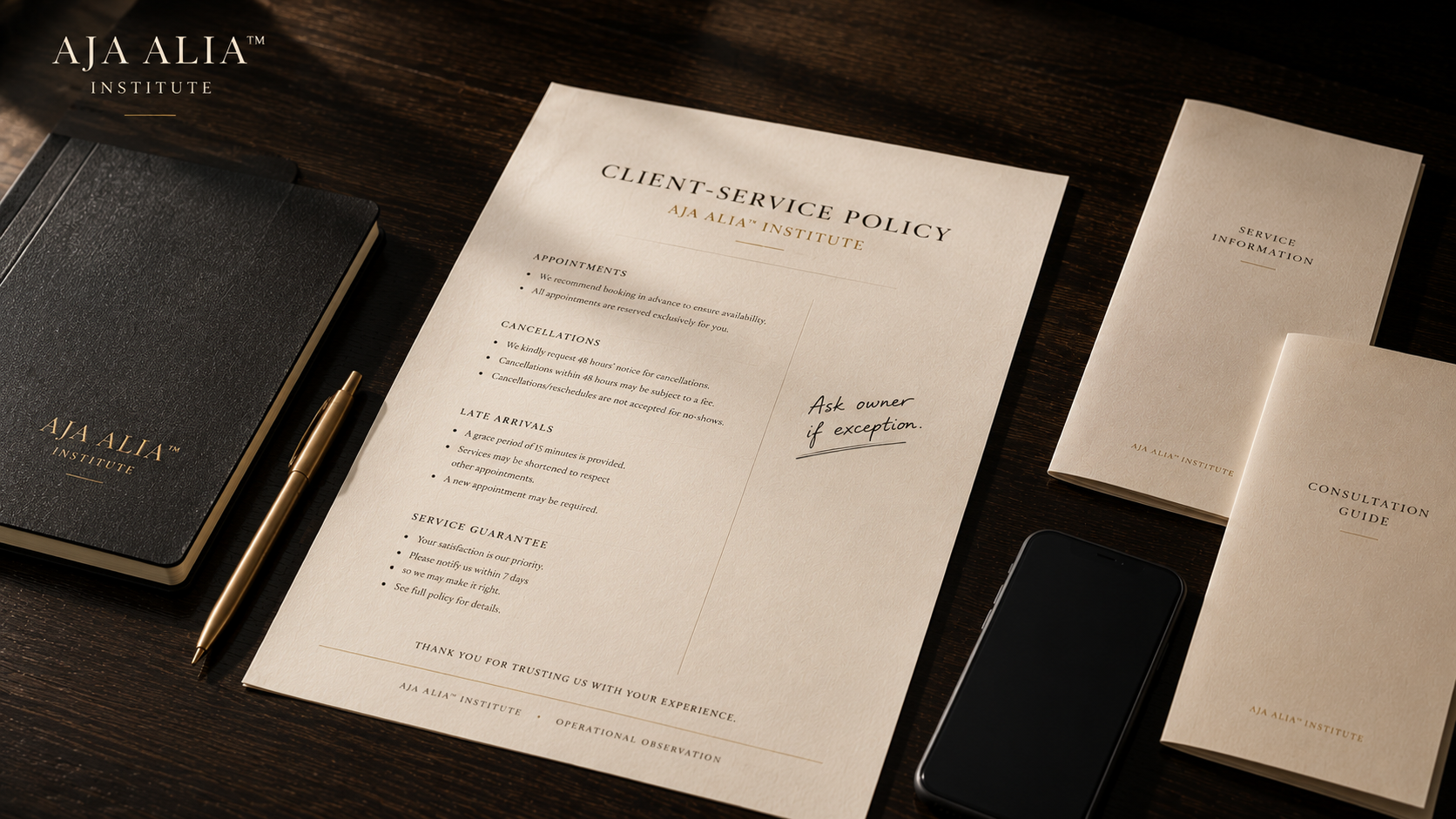
If the same questions, explanations, and decisions repeatedly return to the salon owner, the important question is not simply whether staff need more training. It is what they are actually coming to the owner for.
A luxury client experience depends on more than technical execution. The client experiences the operation around the service: booking, arrival, greeting, consultation, preparation, timing, communication, privacy, comfort, transitions, concerns, checkout, rebooking, aftercare, and departure.
Does that expectation exist somewhere beyond the owner’s own understanding?
How Often Does Someone Say, “Let Me Check With the Owner”?
A client asks, “Can I receive this service if I had another treatment last week?” Or, “Why is my deposit nonrefundable?” Or, “I’m running late. Can you still take me?”
Another client wants to add a service. Someone is disappointed with an outcome. Someone wants to know when to return.
Some of those questions should reach the owner or an appropriate senior professional. Some may not need to.
The first observation is simply that they keep arriving in the same place.
Not Every Question That Reaches the Owner Is a Problem
A contraindication may require expertise. An unusual service correction may require senior judgment. A substantial client complaint may warrant ownership involvement. An exception with financial consequences may require authorization.
Luxury service does not mean allowing every employee to improvise. Sometimes knowing when not to make a decision independently is evidence of good preparation.
The question isn’t whether your staff comes to you. The question is what they’re coming to you for.
Before You Call It a Training Problem, Determine What’s Missing
Repeated escalation does not automatically indicate poor staff performance. The more useful observation is what the owner is supplying when she becomes involved.
Knowledge
Do they know what applies?
Do they understand the cancellation policy, service timing, preparation requirements, aftercare expectations, rebooking intervals, and which situations require escalation?
This is information.Preparation
Can they appropriately apply and communicate what they know?
Someone can recite a policy and still be unprepared to explain it gracefully to an upset client. Knowing the information and knowing how the salon expects it to be communicated are different things.
This is where training legitimately enters.Authority
Do they know what they are allowed to resolve?
Can the front desk make an adjustment? Can a stylist offer service recovery? Who may waive a fee, approve an exception, or decide that a situation requires management?
Clarity about authority changes escalation.Expertise / Judgment
Does this genuinely belong with a senior professional or owner?
Safety, professional assessment, contraindications, complex corrections, unusual circumstances, significant service recovery, and sensitive decisions may appropriately require escalation.
This is appropriate escalation.Luxury Is Often Experienced as Knowing What Happens Next
A client should not repeatedly encounter internal uncertainty: “I don’t know.” “Nobody told me.” “You’ll have to ask her.” “That’s not how I was told to do it.” “The owner normally handles that.”
Luxury should not be reduced to champagne, expensive furnishings, or elaborate hospitality.
A considered experience requires the people delivering it to understand what is expected of them.
That expectation includes tasks, communication, transitions, escalation, and professional boundaries.
What Does Your Staff Need to Know Before the Client Arrives?
Before the appointment
Booking information, service preparation, confirmation, policies, and client notes.
Arrival
Greeting standards, check-in, delays, transitions, and environmental readiness.
Consultation
Listening, confirming expectations, identifying uncertainty, and knowing when technical judgment is required.
During service
Communication expectations, comfort, privacy, timing, service boundaries, and escalation.
When something changes
Delays, dissatisfaction, service adjustments, mistakes, policy questions, and unusual requests.
Checkout
Charges, aftercare, rebooking, next steps, and departure.
The Owner May Be Carrying More of the Operation Than Anyone Can See
The salon may have policies. It may have a handbook. It may have booking software, automated reminders, and staff meetings.
Yet the owner may still carry the connective knowledge: what a policy means in a particular situation; how to explain it without making the client feel dismissed; when to make an exception; what to notice before recommending a service; and how the salon normally handles a recurring situation.
A Tool Can Hold Information. Your Team Still Has to Understand the Experience.
A booking platform can hold an appointment. An automated message can send preparation instructions. A digital handbook can store a policy. But if a client asks what that information means in her particular situation and the answer still exists only in the owner’s head, the operational dependency remains.
The Goal Is Not a Salon That Never Needs You
A luxury salon may depend heavily on the founder’s taste, expertise, judgment, relationships, leadership, or technical ability. Those can be legitimate reasons for involvement.
Your expertise should be needed because the situation requires your expertise—not simply because you’re the only person who knows how the salon expects routine situations to be handled.
The next time you hear, “Let me ask the owner,” resist the urge to diagnose the person first. Observe what the situation is actually asking you to provide.
Call to Reflection™
What does your business still need you personally to explain, decide, or make sense of—and which of those things truly require your expertise?
The Weekly AJA Edition™
Continue the editorial conversation.
Receive one thoughtful editorial each Monday exploring client perception, booking psychology, infrastructure, and the quiet decisions that shape how people experience a service business.
Join the Readership →Related Reading™
Continue through the Observation Library™
Previous Weekly Observation™ The Question Before the Booking Read the observation →Colophon
Publication Record
- Title
- If Every Question Comes Back to You, You May Be the System.
- Edition
- Weekly Observation™
- Field
- Salon Operations & Client Experience
- Editorial Direction
- AJA ALIA™ Institute
- Publication System
- AJA™ Editorial Publication System
AJA ALIA™ Institute · Audit. Archive. Advance.