The Observation Library™
The Audience Without an Address
Visibility produces arrival. Infrastructure decides what happens after arrival.
Weekly Issue™
The observation begins here.
This weekly issue introduces the distance between being seen and being chosen.
Archive Edition™
The observation continues.
Publication 003™ expands the finding into a permanent record of visibility, trust, and booking infrastructure.
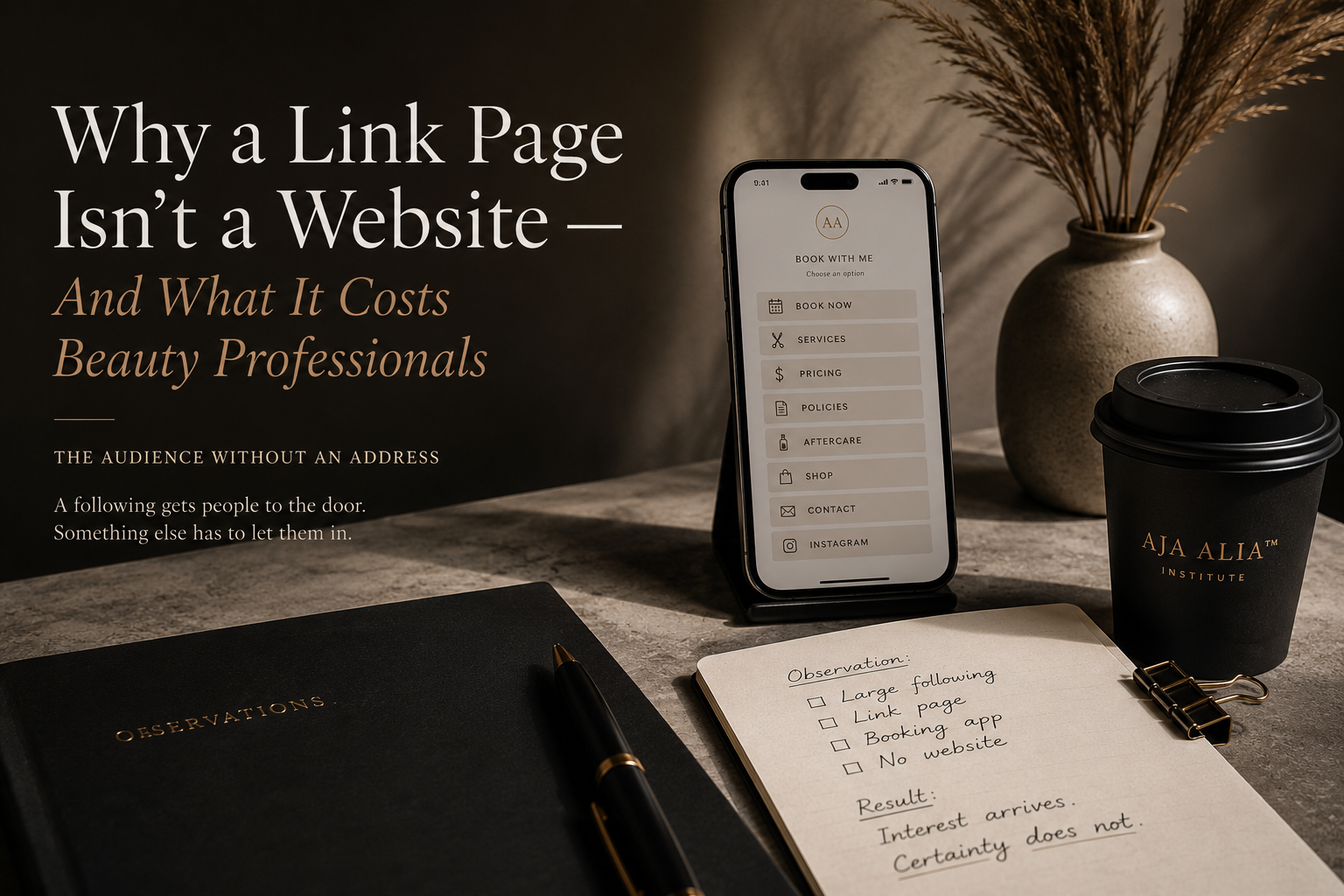
Some of the busiest beauty professionals working today do not have a website.
Not a neglected one. Not an outdated one. None at all.
What they have instead is a following—often a large one—a link page with six or seven buttons on it, and a scheduling app sitting at the end of one of those buttons. That is the entire commercial structure of the business.
And for a long stretch, it holds. The work is good. The audience grows. Bookings come in. Nothing about the arrangement announces itself as a problem, because the thing it costs you never arrives as a complaint.
01 The arrangement makes sense, which is why it lasts
It is worth saying plainly that nobody arrived here through carelessness.
The link page was free and took four minutes. The scheduling app handled deposits and cut down on back-and-forth. The audience was already on Instagram, so building somewhere else felt like asking people to travel for no reason.
Every one of those decisions was reasonable at the time it was made. Together they produced a business with enormous visibility and no place of its own.
That is a different problem than neglect, and it does not get solved by trying harder at the things that are already working.
02 What actually happens after someone taps
Here is the sequence, as a new client experiences it.
She finds your work. Maybe a before-and-after, maybe a client’s post, maybe the algorithm handed you to her. She looks through your grid. She likes what she sees.
She taps your link.
She lands on a plain list of buttons—book, prices, policies, another social account, a product link, maybe a form. She picks one, usually the one that says book.
And now she is standing inside a scheduling screen being asked to choose a service from a list she does not fully understand, commit to a specific date and time, and send money.
Count what she has been told at this point. Not shown—told.
Almost nothing.
She has seen photographs of finished work. She has not been told what happens during an appointment, how long it takes, what the full cost tends to be by the end, what preparation is expected of her, what happens if she does not like the result, or who you are beyond the work itself.
03 She is not shopping. She is checking.
This is the part that gets misread most often.
The assumption is that a person arriving from social media is shopping—comparing options, weighing prices, looking for the best deal. If that were true, fewer steps and a faster booking link would genuinely help.
But she is not shopping. She is checking.
In the few seconds she spends on your link page, she is moving through a short and entirely reasonable list of questions:
- Is this a real business, or something someone does on the side?
- What actually happens when I sit in the chair?
- What is this going to cost me by the end, not at the start?
- What if I do not like it—is there any recourse?
These questions are not suspicious. They are the ordinary caution of someone about to hand a stranger both her money and her appearance.
A list of buttons cannot answer them. A scheduling tool cannot either—it was built to capture a decision, not to produce one.
So the evaluation stalls partway through.
04 A stalled decision looks exactly like disinterest
When someone cannot finish deciding, she does not usually decide against you. She defers.
She saves the post. She tells herself she will look properly this weekend. She screenshots the price list and closes the tab.
Later rarely comes. Something replaces it—a friend’s recommendation, a business that answered the questions first, or simply enough time passing that the impulse fades.
From where you are standing, a person who was nearly certain and a person who was never interested produce exactly the same result: nothing.
That is what makes this pattern so durable. It is expensive and silent at the same time.
05 Why the following hides it
A large audience makes this almost impossible to see from the inside.
When enough people arrive, enough of them will book regardless—the ones who came pre-warmed by a referral, the ones who already knew your work, and those with a higher tolerance for uncertainty.
What the numbers cannot show you is the group who arrived interested and left undecided. That group does not appear in any dashboard you own.
So the business keeps solving for more attention—more posting, more reach, more content—which produces more arrivals into the same structure that was already losing people.
Framework™
Arrival → Evaluation → Certainty → Commitment
06 What a website actually does here
A website is not a nicer link page. That is the framing that keeps this problem alive.
Its function is specific: it is the place you control where a stranger’s questions get answered before she is asked to commit.
It carries the things a feed cannot hold—who the business is, what the process involves, what the range of cost looks like, what is expected of the client, what happens if something goes wrong, and what other clients experienced.
Somewhere in that reading, the questions run out. When a person has no questions left, booking stops feeling like a risk and starts feeling like a formality.
That is the whole mechanism. Not persuasion. Not design awards. The steady removal of reasons to hesitate.
This is the same principle documented in Publication 001™ and mapped through the Five Certainty Signals™ .
07 The distinction worth keeping
Visibility and stability are not the same asset.
Visibility produces arrival. It is what a following is for, and if you have one, you have built something genuinely difficult.
Stability determines what happens on arrival. It is what infrastructure is for, and it does not come free with the audience.
A business can have a great deal of the first and almost none of the second—and it will feel successful right up until growth requires something more than volume.
08 Where to start
Not with a redesign. Not with a rebrand.
Start by walking your own path as a stranger would. Open your link page on someone else’s phone. Tap the button a new client would tap. Read only what she can read.
Then ask the four questions she is asking, and see how many of them your own structure answers before it asks her for a deposit.
Whatever you find there is the real work.
Review precedes prescription.™
Archive Edition™
Continue into Publication 003™
The Archive Edition expands this weekly observation into a permanent study of visibility, trust, and infrastructure.
Enter the Archive EditionInfrastructure Review™
Review precedes prescription.™
The Luxury Booking Infrastructure Review™ examines the complete client path and identifies where certainty is lost.
Begin Your Infrastructure Review™Colophon
Publication Record
- Publication
- Publication 003™
- Issue
- The Distance Between Being Seen and Being Chosen
- Cover Story
- The Audience Without an Address
- Edition
- Weekly Issue™
- Editorial Direction
- AJA ALIA™ Institute
- Publication System
- AJA™ Editorial Publication System v1.0